

Wings of Freedom
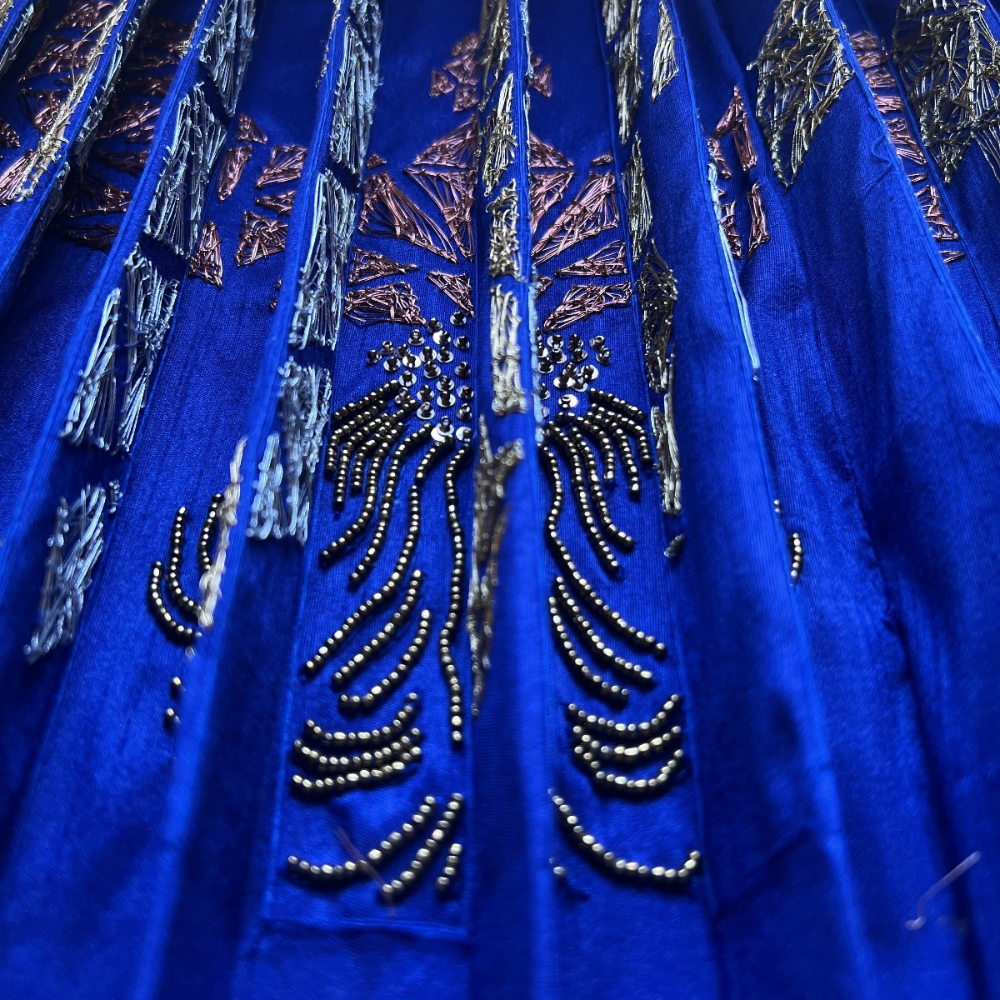
Wings of freedom Wings of Freedom An exploration of material, illusion, and form Wings of Freedom was inspired by a butterfly motif created by one of the participants during the Stitching and B**ing workshop series. What began as a small spark of inspiration soon evolved into a larger experiment combining my fascination with optical illusions and my love for working with metallic materials. I’ve always been drawn to exploring and manipulating materials—particularly metallic zaris, sequins, and beads. The journey for this piece began with the circular drawing technique, which I initially sampled using cotton threads and an aari hook. I was intrigued by the illusion it created when filled within geometric shapes—it was structured yet visually playful. Though I’m not usually drawn to pure abstraction, I enjoy incorporating traditional motifs and reimagining them with a contemporary twist. While experimenting with a winter palette during the workshop, I applied the circular drawing method using the aari technique. What struck me most was not just the visual illusion it created on the front, but the tactile texture on the reverse side—it had a surprising sculptural quality. That textural richness led me to extend the technique further, this time using metallic threads, sequins, and beads.And thus, Wings of Freedom came to life—an interplay of technique, material, and transformation. The piece resonated strongly with viewers and became an instant hit, affirming the power of experimentation and intuitive design. – Priyaguna https://nayamdesignstudio.com/wp-content/uploads/2025/08/nayam-vid.mp4
Transbee
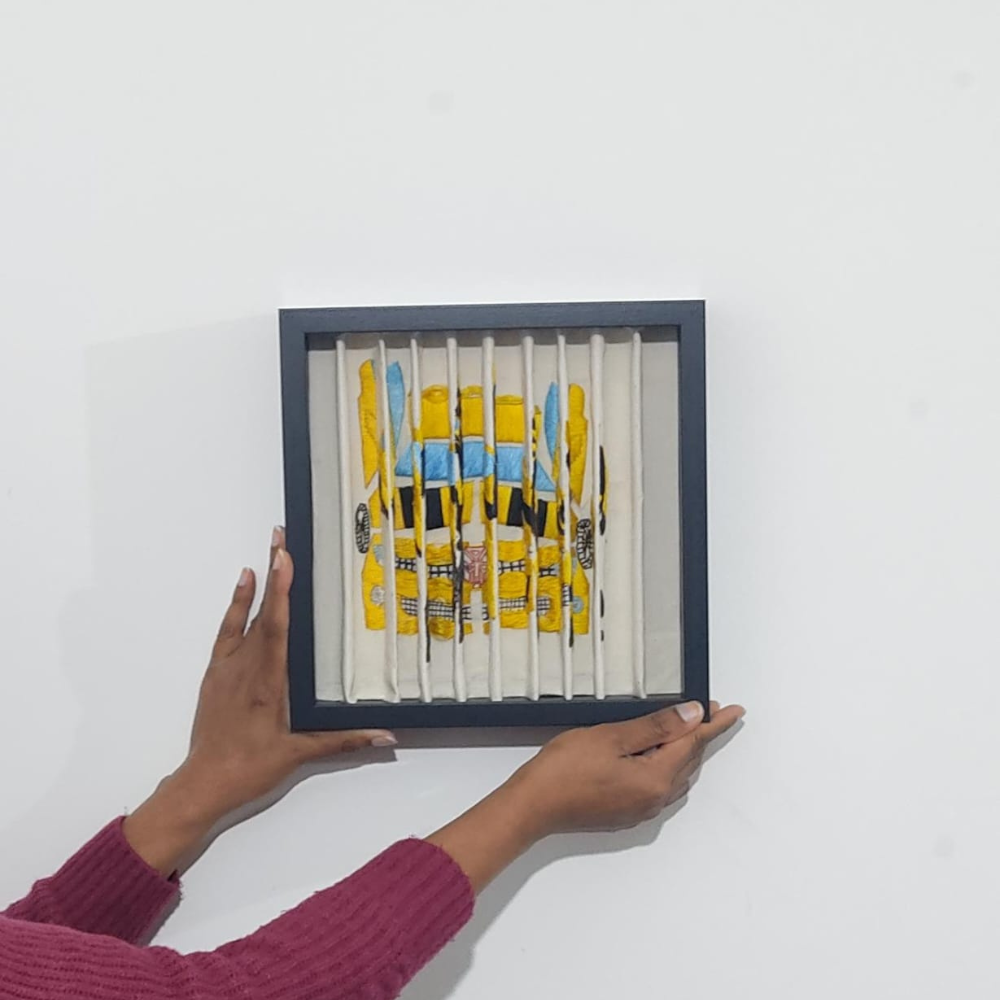
Transbee Transbee Inspired by “Wings of Freedom” Embroidery has been a part of my life for as long as I can remember—since I was much younger! I practically grew up in my mother’s studio, surrounded by threads, beads, and fabrics. My earliest “hobbies” were stretching French wires, mixing up beads, and unravelling embroidery threads—much to the bemusement of my mother’s team, who somehow always put up with me. Looking back, I think that’s where the roots of my fascination with embroidery lie. I wouldn’t yet call it a passion, but I’d say I’m deeply intrigued and definitely fond of the craft. I’m pretty sure my mother tricked me into doing Transbee. What started as an idea for a simple standing bumblebee evolved organically into a lenticular version—a more ambitious and dynamic take on the subject. I had previously participated in a few of her workshops, mostly out of curiosity, and found encouragement from seeing the other participants’ work. But Transbee became my very first completed embroidery piece. Over the years, I had watched my mother use various stitches, and while I didn’t always know their names, I could understand how they worked and why she chose them. That instinct came in handy while planning stitches for Transbee. Creating a stitch direction sheet before starting the actual embroidery helped tremendously—it was like having a roadmap. In fact, to my mother’s surprise, I even corrected her on a few stitch placements!For Transbee, I used a combination of satin stitch, French knots, battlement couching, backstitch, running stitch, and buttonhole stitch. I later realized I had used satin and laid work interchangeably—something I picked up along the way. A special mention goes to the RSN Stitch Bank, which was incredibly helpful throughout the process. Working on Transbee turned out to be an enjoyable and fulfilling experience—and the cherry on top was winning the National Embroidery Competition 2025! – Tharan
NeedleStitcheStories
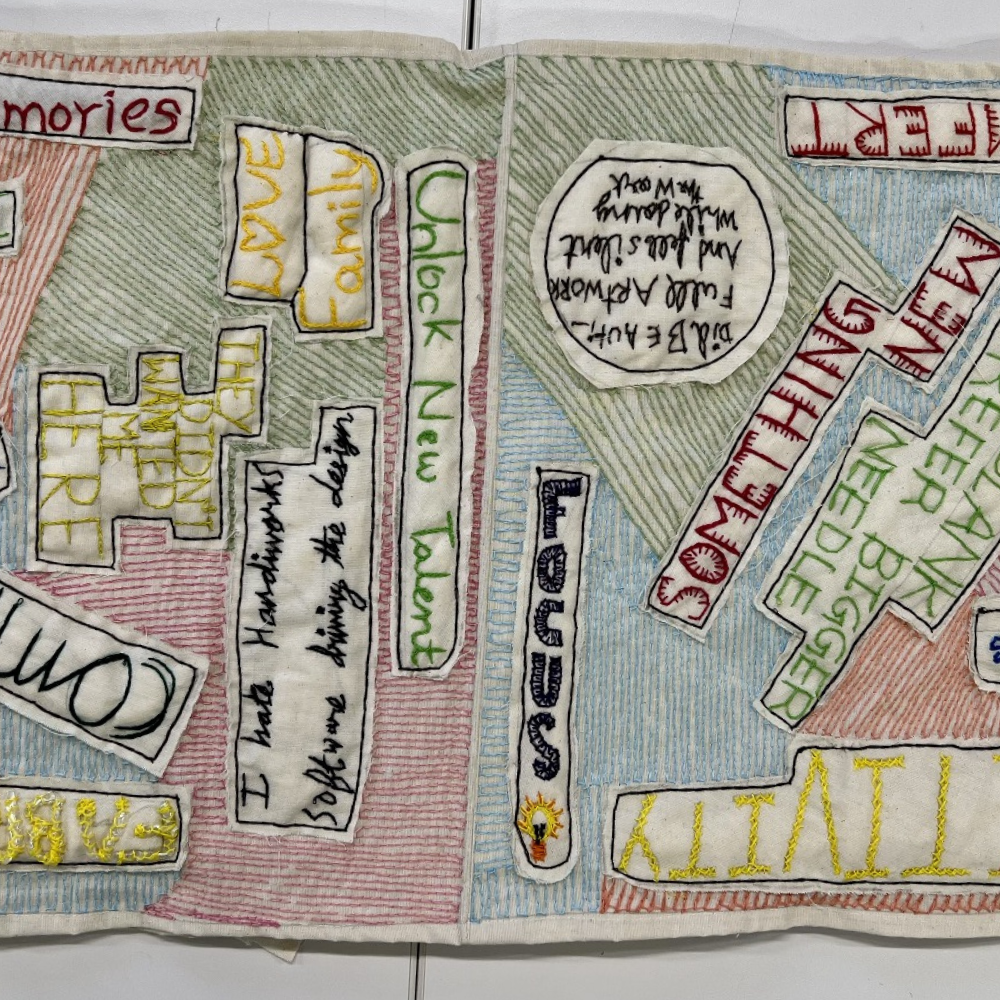
Needle Stitches Stories Needle Stitches Stories NeedleStitcheStories was a community-centered inquiry into hand embroidery as a creative and meditative collective practice. The project aimed to reintroduce embroidery to a group of participants through a series of workshops titled “Stitching and B****ing”, conducted over a span of three months.The workshops were themed around nature, and participants were encouraged to create their own embroidery designs inspired by nature. My role as the facilitator was to guide, support, and step in when problem-solving was needed—allowing participants the freedom to explore embroidery in their own way. There were a few beginners and I had to teach them stitching.A key aspect of the workshops was a fabric spread across the table on which participants could freely write their thoughts and feelings as they stitched. This became an organic feedback mechanism and a form of expressive journaling. They were invited to write whatever came to mind—without prompts or filters—resulting in a spontaneous and honest tapestry of shared moments.This exercise turned into a surprising highlight of the series. Initially an icebreaker, the fabric soon captured the pulse of each session: reflections about stitching, snippets of conversation, song lyrics from the background, references to the IPL cricket matches—essentially a live documentation of the collective experience. Participants wrote in their native languages, which resulted in the final fabric incorporating 11 different scripts: Tamil, Telugu, English, Malayalam, Sinhalese, Arabic, Hindi, Marathi, Gujarati, Kannada, and Bengali. At the end of the series, I stitched over all the handwritten feedback and compiled it into a large appliqué artwork approximately 3 meters in length. The final piece served as both a visual archive and a symbolic layer of collective memory. The core intention of NeedleStitcheStories was to create space for interaction between the participant and the craft. Many participants shared that the workshops offered them a welcome break from their routine—a meditative space where they felt no pressure or judgment. They stitched for the simple joy of stitching, finding relaxation, connection, and creative fulfillment in the process. – Priyaguna

